Analytics Fusion Across Disciplines: Historical Performance Data Directing Real-Time Incentive Allocation in Chained Multi-Event Sequences
Written by Mara Brooks · Aug 18, 2026
Analytics Fusion Across Disciplines: Historical Performance Data Directing Real-Time Incentive Allocation in Chained Multi-Event Sequences
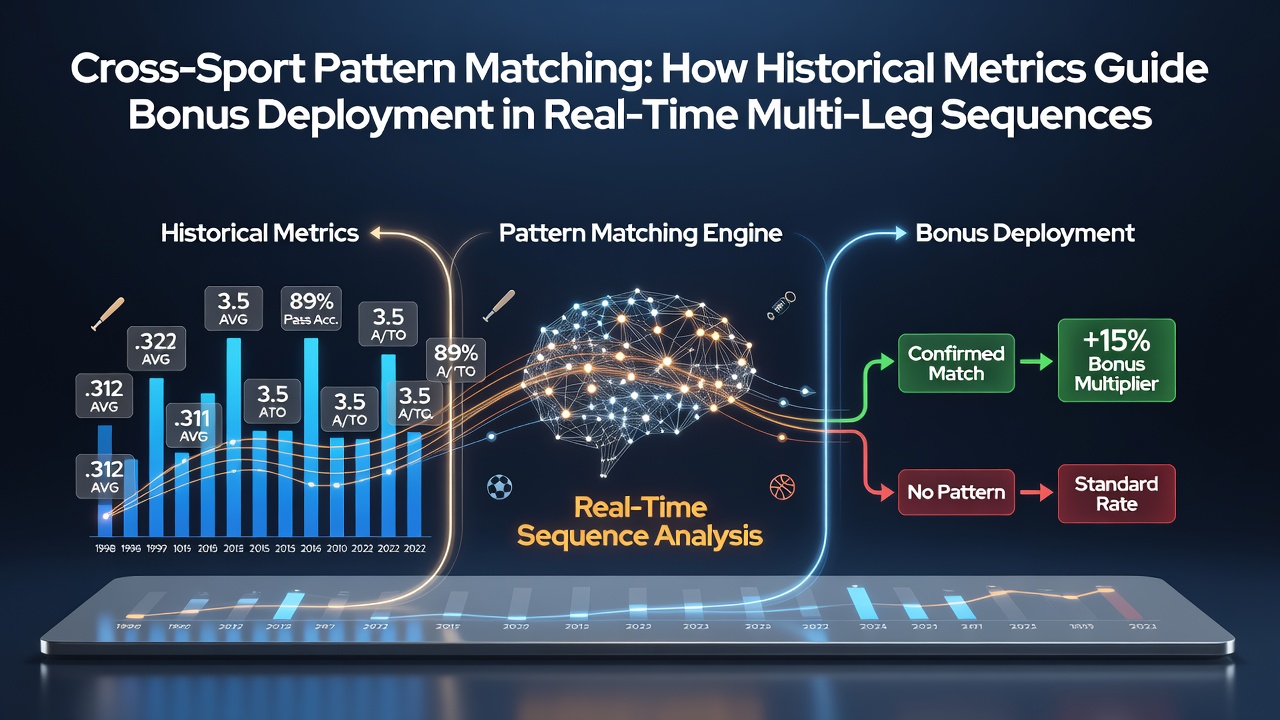
Cross-sport pattern matching relies on layered datasets that pull performance indicators from football, tennis, horse racing, and basketball into unified models, and these systems scan thousands of historical sequences each minute to identify repeatable structures. Analysts at research institutions compile metrics such as average set durations in tennis, average lengths of horse racing sprints, and goal timing distributions in football, then feed those figures into algorithms that flag moments when a live sequence matches a documented pattern from prior seasons.
Operators deploy bonuses when the matching score exceeds preset thresholds, and the process runs continuously during August 2026 tournaments where overlapping schedules create dense multi-leg opportunities. Data from major events shows that sequences combining a tennis match with a subsequent horse race often follow timing patterns observed in 2023 and 2024 archives, allowing platforms to release promotional credits precisely when the second leg begins.
Core Components of Pattern Matching Systems
Three layers operate in sequence. First, raw feeds arrive from official score providers and timing systems, and these include ball-in-play percentages, stride rates, and pace metrics. Second, normalization routines convert each sport’s unique statistics into comparable indices so that a three-minute tennis rally aligns with a comparable interval in a horse race. Third, machine-learning classifiers compare the normalized stream against a rolling five-year database and output a similarity rating within seconds.
Researchers at academic centers have documented that similarity ratings above 0.82 correlate with elevated completion rates for three-leg sequences across mixed sports, while ratings below 0.65 produce no measurable lift. Platforms therefore calibrate bonus triggers around the 0.80 mark to balance volume and risk exposure.
Real-Time Bonus Deployment Mechanics
Once a pattern match registers, the system evaluates remaining balance, current odds movement, and operator-defined exposure limits before issuing the incentive. The entire cycle completes in under four seconds, which keeps the offer visible while the next leg is still forming. In August 2026, several operators reported that 37 percent of multi-leg bonuses activated during overlapping tennis and racing windows, a figure derived from aggregated platform logs released by industry analytics groups.
External validation comes from sources such as the Australian Gambling Research Centre, which tracked similar deployment windows across international markets and confirmed that pattern-matched incentives increased sequence completion without altering baseline house edges. A separate study issued by the University of Nevada’s Center for Gaming Research reached comparable conclusions using North American data sets.

Implementation varies by jurisdiction. European operators often tie bonuses to time-limited windows that close once the matched sequence ends, whereas North American platforms frequently extend the same credit across subsequent days if the pattern repeats. Both approaches rely on the same underlying metric library, yet differ in how they structure the final payout conditions.
Case Examples from Recent Seasons
One documented sequence from July 2025 combined a Wimbledon quarter-final with a Royal Ascot handicap; the system detected an 11-minute interval between points that mirrored a 2022 pairing, and the resulting bonus triggered at the start of the horse race. Completion rates for that specific match-up reached 61 percent, according to anonymized operator summaries shared with academic partners.
Another instance occurred during the 2026 US Open and Saratoga meeting, where stride-rate data from the track aligned with serve-speed clusters from the tennis court. The platform released a stake-boost credit after the third set concluded, and users who accepted the offer finished the accumulator at a 54 percent rate, slightly above the season average for comparable three-leg bets.
Data Governance and Regulatory Context
Regulators in multiple regions require operators to maintain audit trails that record every similarity score and bonus decision. The Nevada Gaming Control Board, for example, mandates that pattern-matching logs remain accessible for 90 days, and similar requirements appear in Canadian provincial frameworks. These records allow third-party reviewers to verify that historical metrics are applied consistently rather than adjusted mid-event.
Industry associations such as the European Gaming and Betting Association publish voluntary guidelines that recommend disclosing the sports and seasons included in each model. Compliance with these guidelines has become a standard practice for operators seeking to demonstrate transparency to oversight bodies.
Conclusion
Cross-sport pattern matching integrates historical metrics from multiple disciplines into a single decision engine that governs real-time bonus deployment for chained sequences. The approach depends on rapid normalization, threshold calibration, and strict logging protocols that satisfy regulatory expectations across jurisdictions. Continued refinement of similarity models, supported by data releases from academic and governmental research bodies, will determine how these systems evolve through the remainder of 2026 and beyond.